A couple of weeks ago, I was peering into the darkness, looking out for even the tiniest glimpse of light. This was just prior to the US election, so the darkness outside involved an Eastern European landscape rather than a global political one.
I was in an old-fashioned, six-seater carriage of a train, trundling north from Bucharest to Transylvania. In this part of the world at least the occasional flash of light, shining out in the night, could be seen (although Romania currently has its very own right-wing populist standing for election).
Every so often the train stopped at an apparently isolated station – set in the middle of an expanse of shadowy fields, or dark wooded hills, stretching up and up beyond my canvas-like screen of window, in a great banking mass of trees.
A couple of passengers would get off and could be seen walking alongside the train for a few steps before disappearing into the night. Leaving me to wonder, where they were going. I assumed the nearest town or village must be nestled on the other side of the hills.
At each station, a red capped staff member stood on the platform in front of the building, holding up a lamp and a flag – checking all was well. On their signal, the train would judder and move off again. I liked to look back and watch the small beam of those station lights and lamps recede into the distance.
I was at last fulfilling a long-held desire to visit Transylvania. Fuelled initially as a child by thoughts of Dracula, vampires, ghosts, but also the idea of vast expanses of forest, filled with wolves, wild cats, bears, lynx and more.

In addition to Bram Stoker’s version of this fabled land – which he famously never visited, my fascination was primed further by a large-format illustrated book I’d been given one Christmas, called ‘A traveller’s guide to Transylvania.’ As with all the best books, this had a map on the frontispiece. Inside, every other page presented a full-bleed (uh huh) illustration of weird denizens in a sepia-tinted, bizarre, antique, horror/fantasyland. Maggoty corpse faces, jagged mountain peaks, suspicious villagers twitching behind wooden shutters, ghosts, ghouls and an extensive cast of fearsome, earthbound and supernatural beasts crammed between the covers.
Later, my youthful impressions of Romania – specifically Transylvania – were added to by Patrick Leigh Fermor’s ‘Between the Woods and the Water’. This contained fewer vampires, but plenty of trees, wildlife and romantically rugged, crumbling hilltop castles and towns.
By the time I arrived in person as an adult, I doubted the authentic Romania would be anything quite like my book-fuelled childhood visions – however much I might want it to be. This was swiftly affirmed by the ranks of insta-friendly coffee shops, buzzing bars, graffitied walls, traffic-jams and massive apartment blocks of Bucharest.
Contemporary, post-Ceaușescu Romania, or its capital at least, was, in many ways, not unlike other major modern European cities. Beyond some beer brands and ads, I saw no bears or bats. There were though, an awful lot of crows.
We soon found our way to Bucharest’s imposing Gara de Nord station. Beneath its stretching roofs, a striking, possibly 1960s-vintage, departures board had me and my travel companion (a woman not frequently given to overly enthusiastic public displays of excitement) gawping in delight. Vienna, Budapest and towns and stations across Romania flickered temptingly across its face.
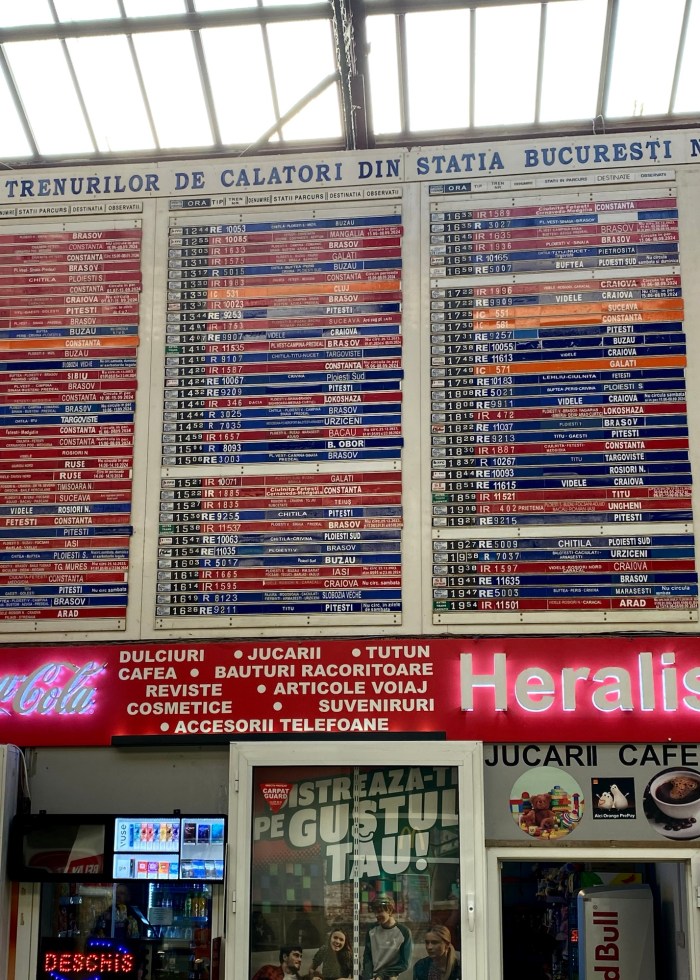
I always find the atmosphere of a big, bustling train station an exciting prospect. Far more so than the glaring non-spaces of an airport. This one was no exception. Our destination was Sighisoara in the Transylvanian highlands – a place the tourist websites describe as ‘Europe’s last medieval landscape’.
There, after a six hour journey through plains and mountain valleys, my desire to snatch a glimpse of the myth-haunted realm of my imagination, was fulfilled.
This small city looks at first glance as if a team of medieval architecture fanboy giants had snatched-up great chunks of Prague and Bruges and squashed them onto a hilltop, surrounded by misty vistas of even taller, wood cloaked peaks.
The walled old-town, turrets, spires, sleepy dogs, cobbled streets, painted houses, wooden walkways, steep steps and vast, vaulted churches more than answered the fairy-tale promise of the travel guides. Topped by the city’s nine surviving ancient towers (turnul). Fourteen guarded the walls originally – each built by a different guild – including furriers, butchers, blacksmiths, weavers, ropemakers, tanners and tailors. Most impressive of all was the Clocktower, a great, thick-walled edifice, topped with a set of spiky turrets.
Sighisoara is the reputed birthplace of Vlad Tepes, aka the Impaler, Vlad Dracul, aka – proto Dracula himself. Although here, unlike in Bran Castle to the south – often promoted as Dracula’s Castle, with all the attendant tourist-baiting kitsch gothickery you might expect – they don’t overdo the barbarous, stake-happy vampire stuff.
Here, Vlad Tepes is remembered more in a heroic, nationalistic way, as an important warrior-ruler. Closer to our treatment in England of Henry V.


From here, we headed back south, to Brasov – a bigger city, built right up against its own mountain – Mount Tampa. In case you didn’t know where you where, there’s a big white Hollywood Style sign on the top, which lights-up at night.
More sprawling than its northern neighbour, Brasov – with its picturesque plazas, narrow lanes, hidden courtyards, enticing restaurants and bars– not least a classic dingy, sticky-floored rock-bar, down an alley, blaring out metal and industrial tracks – has plenty of its own architectural and atmospheric charm. The old town, dominated by the massive Black Church – so called because of a fire, rather than any more occult history – from certain angles looks like a place scooped straight out of Grimm, or a cut scene from a video game – presenting the sort of vista Geralt of Rivia might gaze down upon, as he and trusty steed Roach make their way out of the wild woods, looking for some cod-medieval urban action.

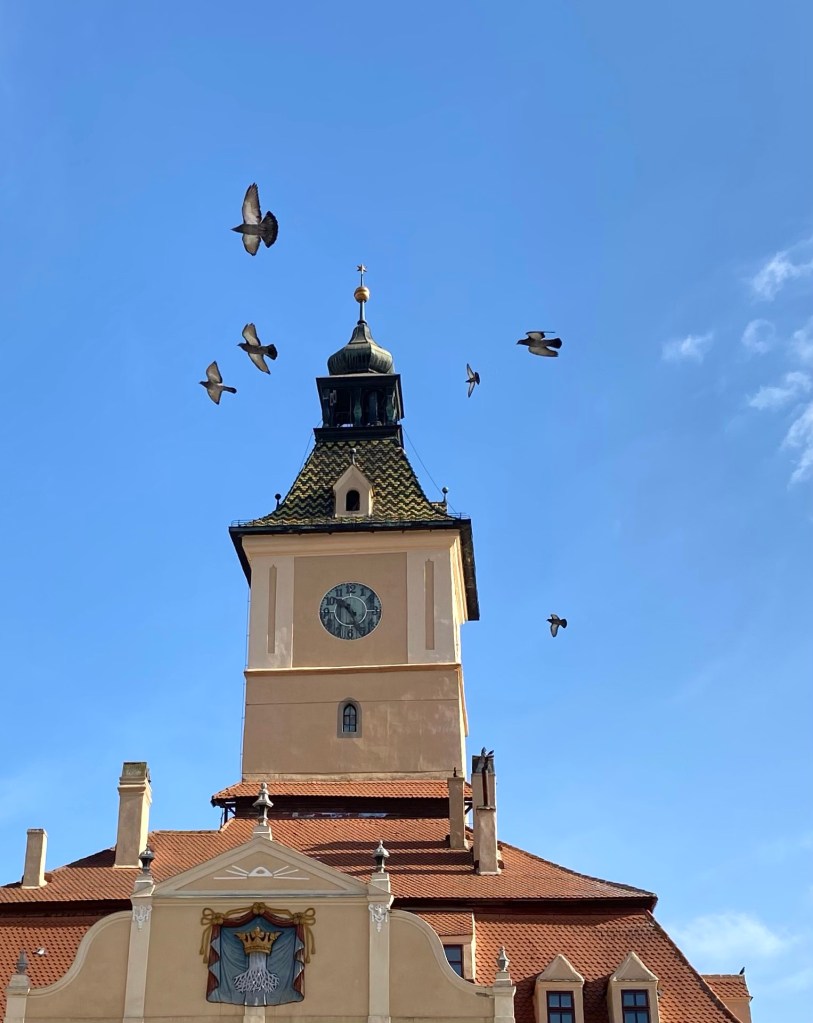

By now, the supernatural, folklore loving part of me was well and truly sated. Next-up, I wanted to walk into the trees. Given that you can step quickly from a busy street with a supermarket into the steep, wooded slopes of Mount Tampa, this was easily done.
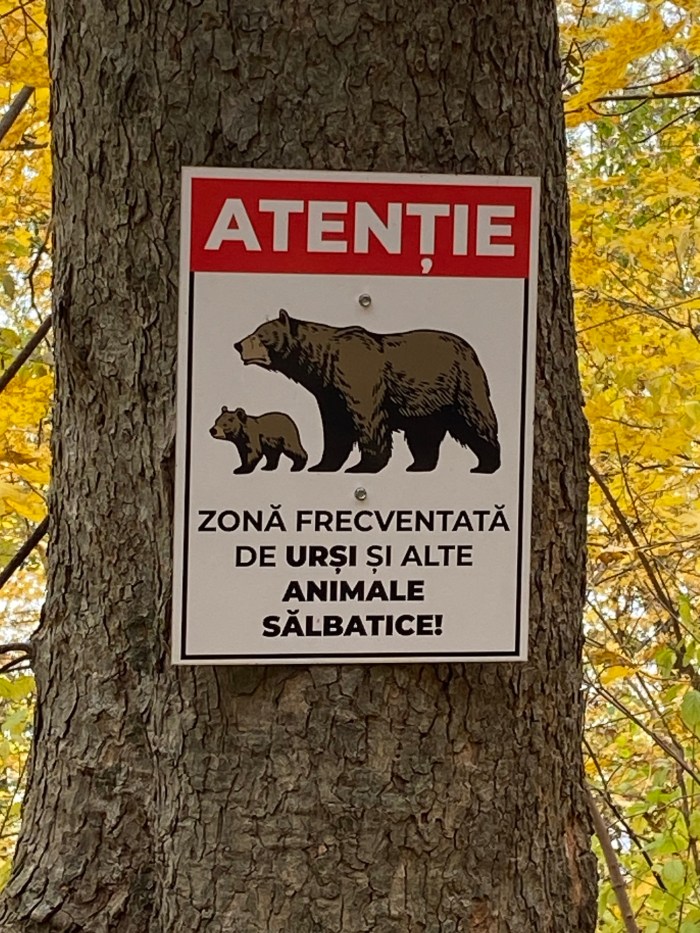
In Britain I’m used to information boards highlighting landmarks, historic sites or if you’re lucky some wild-fowl or birds of prey you might catch sight of. Not far off will usually be a hand-painted warning against straying off the narrow path by some perma-furious, sclerotic local landlord. Here, not five minutes stroll from the city streets, signs cautioned visitors to be wary of potential encounters with lynx, boar, viper, wild cat, castor bean tick, wasp or brown bear.
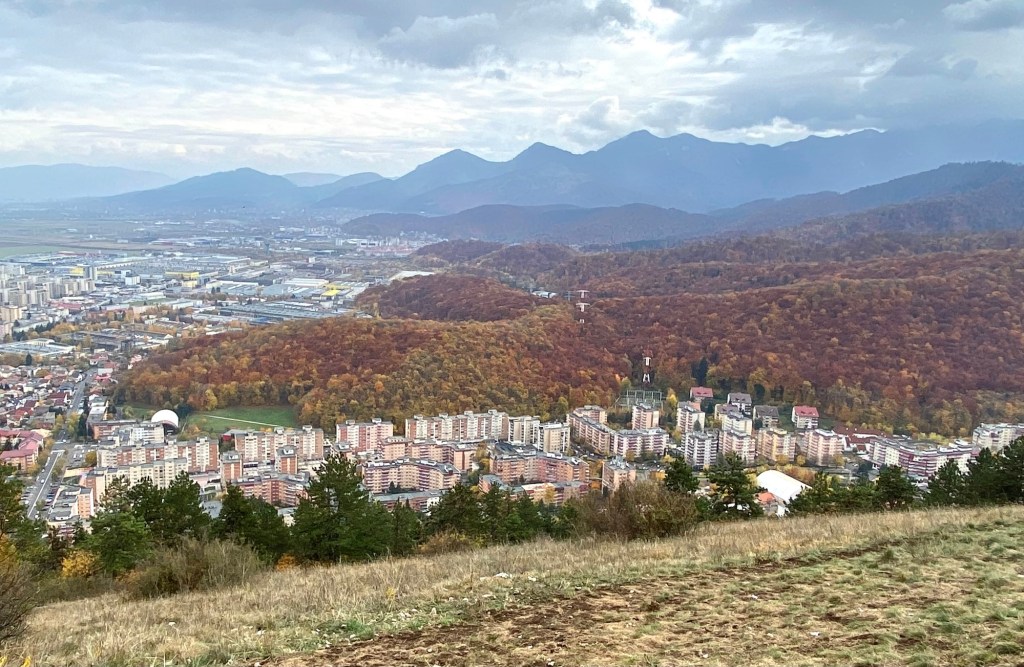
During the middle of the morning, hard-by a city I didn’t really expect to see any of these, but the idea that out-there, maybe not far away, these creatures were getting on with their lives, made me giddy. We climbed to the top. Saw the back of the giant Brasov sign and looked down to the other side of Mount Tampa. Far below, a group of tower blocks marched out of the city edges, right up against the lower slopes of another hill. There was no green-belt here. Urban buildings, then, wham, forested hills. Beyond these, taller peaks stretched into the distance, all of them covered in trees.
We decided to press on, following a trail deeper into the woods. These were dominated by tall, slender, silvery beech trees. All turning for autumn. Above us, a tapestry of burnt lemon husk, marmalade and russet shades quivered. Constantly scanning off the trail, between trees for creatures, every old stump became a crouching beast. I did see what I’m fairly certain was bear scat, but other than pictures on signs, this was as close as we got. By a small mountain brook, we did see a tiny frog, the same tint as the autumn leaves.



On reaching the bottom of the valley, we discussed turning back before dusk. There, we did have a memorable wildlife encounter. Not involving any sort of charismatic mega fauna, nor a raptor, or strange insect, but a tiny, common bird. On either side of a stream, something or things, small was flitting between trees. We stopped talking. Two, six, fourteen and more of these small shapes appeared, darting rapidly between three different points.
Now hushed, we could hear their faint chatter. Creeping a little closer, we realised these small birds were common blue tits – pițigoi albastru to Romanians. Even in nature-depleted Britain, unremarkable and not yet rare. But in the depths of these woods, which stretched away for mile after mile north and east of Brasov, it felt as though we’d stumbled into a private moment, which if we kept quiet, we’d briefly be allowed to witness, if not share. Maybe they’d discovered some mass gathering of aphids and were taking their fill. Something about the numbers involved, the near silence and the sheer busyness of these little birds, lost me for a few moments, in an oddly delirious, near transcendental kind of calm. In the background, a soft breeze pushed through the beeches, gentle, but firm enough to detach the flaming leaves, creating a steady, sigh-filled fall of paper rain. The light was fading, we decided to retrace our steps to Brasov before dark descended with night once again.


 Richly Evocative
Hey,
thank you for this beautiful and suitably evocative piece of writing. Until now I’ve never had a desire to visit Romania (I am squeamish about Vlad) but this made it into an enticing fairytale adventure. Now I really want to visit. Also, the Guardian article you linked to is incredibly helpful to me – I’m a composer and about to premiere a couple of pieces choral in New York, the first is a setting of the common meditation ‘May I be filled with loving-kindness, May I be well, May I be peaceful and at ease, May I be happy’ but the second was written on November 6th and I’ve been trying to articulate exactly why I wrote it, what I really meant by ‘hope’ – this article does all of that and more!
Thank you.
Pete
PS. Should you care to read it, here’s the text of the second piece:
Street Motet No. 2. Whatever Happens Next
whatever happens next
bring love into the world
whatever comes next
bring kindness to the world
don’t give up hope
or if it’s too late for that
plant the seeds of new hope for tomorrow
whatever cause you have for scorn
bring kindness to the world instead
when tempers rage, when anger reigns
choose to reply with reckless grace
for every bit of ugliness thrown on the day
be the first in line to throw back beauty
whatever blind injustice breaks your heart
whatever fury breaks upon your shore
be the one who brings some peace back to the world
every time we return love for hate
the reservoir is refilled a little
and love wins
whatever happens next
you’re never on your own
despite how it feels, sometimes
plant the hardy flower of hope in your backyard
or better still behind the ugly gas station
don’t believe the troubled voice
that says we’re doomed and all is lost
there’s plenty of good still to be found in the world
be part of it
in a thousand small actions
in a single word
or in one defiant moment
whatever happens next
keep this promise:
trust that your one unseen gesture
ripples out through darkness to unseen shores
and whatever comes next
hope will never be lost
LikeLiked by 2 people