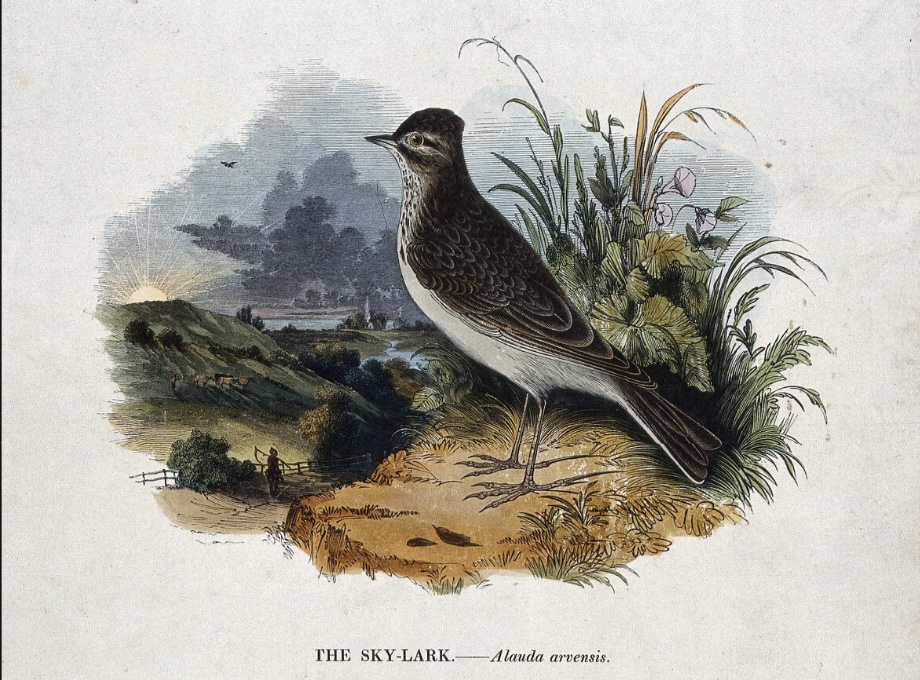
Credit: A sky-lark sitting on a rock before a bucolic landscape. Coloured wood engraving by J. W. Whimper. Wellcome Collection. Source: Wellcome Collection.
Every once in a while, I enjoy a run of publication. This January I had three poems published on three different sites. Ink Sweat & Tears, Dust and Winged Moon.
More often than not, this represents an accident of timing, rather than suddenly having hit a rich seam of inspiration. Behind the scenes, the acceptances for these poems did not all arrive at the same time; rather, they came in between the usual run of ‘I don’t think it’s right’,
‘I was not able to include this work’, ‘Unable to accept at this time’, ‘You what?’ , the horrific squall of email tumbleweed etc.
It can be easy to obsess over what exactly each polite rejection, or non-response means. I doubt I am alone in having wasted much time in wondering quite what ‘not right’ actually signifies – ‘not right’ for this particular issue/publication/editor? Or does the journal/editor mean the poem itself is somehow wrong, flawed – or me, my life and all that I represent ?
Over time I have found that the more work I send out there, in the hope of finding it a home, the better able I have got at not overly worrying at the meaning of a ‘not right’ or its equivalents. Mostly I put these down to the fact that a particular poem, or set of poems, simply hasn’t grabbed the editor.
As a reader – whether for pleasure or because you have to for work/editorial purposes, when you read something that resonates, has you re-reading, punching the air, nodding furiously, crying, laughing, whooping, it’s brilliant. Sadly, many more poems will not evoke such enthusiasm. And yet they might in someone else.
Plenty of published poems I’ve read, many in highly respected journals and magazines, which an editor, team and readers must have liked, loved, admired etc, have left me cold.
There are entire novels, films, paintings, which I know are critically admired, fawned-over, delighted in, that I have picked up and read, or been to see and for me, they’ve fallen flat. On occasion, I’ve even wondered if I have somehow misread, or failed to look properly, such is the gap between my befuddled state of ‘That’s it?’ and the widespread acclaim certain works have gained from others.
As someone who has perhaps spent rather too much time, trying to analyse the meaning of ‘meh’, I increasingly believe that we ought to instead appreciate the mystery of subjectivity. A consensus over what constitutes good, bad, radical, boring, tired, exciting would be awful, wouldn’t it?
Even if somehow an objective system designed to measure the quality of a piece of art was developed, I’d feel duty bound to disagree.
Recently, for the first time, I stopped reading a novel that I wasn’t getting much out of, rather than completing it out of a sense of duty. Instead – after a brief burst of guilt, I cast it aside – well, stuck it in the local free book box – and it felt great.
In a strange way, the fact that what excites and inspires one individual, may leave another reader, or observer, feeling utterly indifferent, can be exciting.
All the more reason then to celebrate when something you’ve created does resonate with someone else, and if you’re lucky, someone-elses plural.
Perhaps one of these will with you, or not:
If you didn’t know what a storm is – Ink Sweat & Tears.
What Larks Dust
Out of the dead wood Winged Moon – Hinterland


 Richly Evocative