When off-stage, or screen, Actors ‘rest’. Copywriters read, or at least they ought to.
So, yesterday, being in the latest in-between phase of the freelance copywriter life (a phase increasingly lengthier than the active project/gig phase itself, as the three-headed apocalyptic career assassins of AI, Age(ism) and Advertising Eating Itself advance upon my territory with rusty virtual axes – ok that last one is a stretch), I re-read The Great Gatsby. Well, it certainly beats LinkedIn.
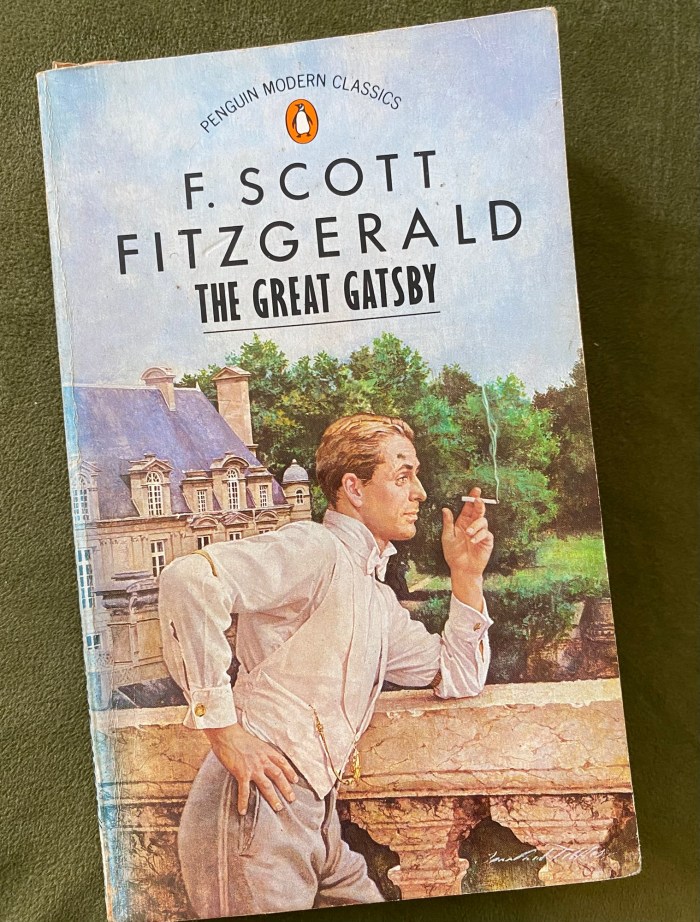
So, do I have anything new, sage, or profound to say about Mr James Gatz? No. But, having been propelled into the pages of this modern American Classic once again, by a BBC iPlayer strand, where someone ‘Remembers’ something: in this case ‘Sarah Churchwell Remembers The Great Gatsby’ – (it’s more usually a cult classic 1970s or 80s BBC TV production, such as Phil Davies on The Firm, or Kate O’ Mara Remembers Triangle*), I was reminded – arf – just how bloody exceptional the writing is. Famously, Fitzgerald worked and re-worked his prose in the novel until it sparkled; producing moments of stunning description, or wit, or brilliant observation. And it shows.
Since last reading the novel, which I first read in 1990, according to my dated signature on the flyleaf, I had forgotten most of the plot and many of the details. All I’d retained was a vague impression of atmosphere, those yellowed, giant bespectacled eyes, and the last line. Still in my teens, everything – life, culture, the future, seemed brighter and more promising then. It seems a much darker world and novel now.
This time around, having noted their regularity in descriptive passages, I suspect that an in-depth study of Fitzgerald’s use of light and shadow could be made (and quite probably has) on how this provides oblique commentary on the novel’s characters and action.
The other key thing I noticed, aside from the general, sheer brio and style of the writing, was just how fucking awful everyone in the novel is. Ok, Nick Carraway the narrator isn’t the worst, but his self-declaration of helpless ‘honesty’ makes him at the very least, a suspicious little prig. An unreliable narrator, adrift among an unreliable cast of other characters.
Viewed through the prism of today, 2020s USA in particular, it’s depressing to see how little has changed in some people’s behaviour over the course of the last century – or at least, as seen through classic literary depictions of certain echelons of North American society.
These characters, major and minor are all selfish cheats and liars, braggarts and/or drunks. Many acting as bitchy courtiers around the glow of the faker-in-chief at the centre. Sound familiar ? – well, Gatsby at least was self-made, albeit illicitly, and did go off to war and seemed to care about more than self-enrichment. Love, perhaps, or at least the idea of it.
That I’m far from alone in thinking this, can be attested by the currently much quoted line about Daisy and Tom’s ‘vast carelessness’. Which brings me to a nagging question I’ve maintained; one not answered by this re-reading: does Tom Buchanan know that Daisy was driving Gatsby’s car, when she hit and killed Myrtle Wilson? Or to put this another way, does Daisy tell him?
Nick Carraway glimpses Tom and Daisy later through a window of their house, Tom’s hand on top of Daisy’s, in an apparent scene of conspiratorial togetherness, but he doesn’t know for sure. If Daisy didn’t tell Tom, does that make her betrayal worse, more self-serving and amoral? In that case, what else did she lie about to others, to Gatsby and herself? Tom is the more obvious ‘baddie’ – racist, violent misogynist that he is – but Daisy’s behaviour, cuts deeper, feels more insidious.
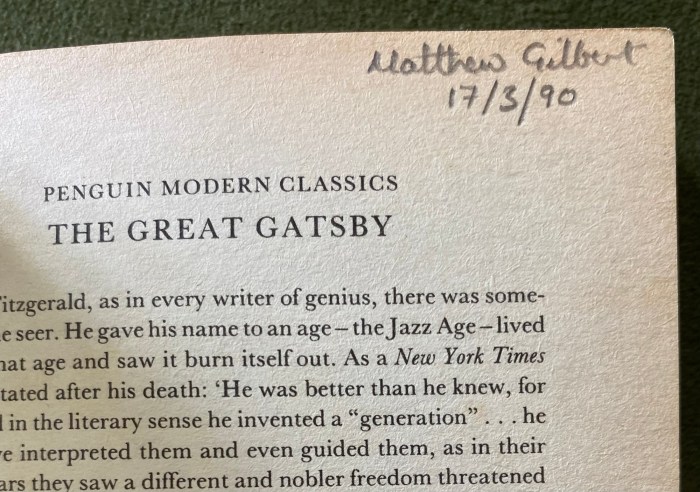
In 1990, young me, had marked the page, with the aforementioned ‘vast carelessness’ passage, [172 in my Penguin Modern Classics Edition] but not for that quote, back then I’d been taken with one on the facing page:
“I became aware of the old island here that flowered once for Dutch sailors’ eyes – a fresh, green breast of the new world. Its vanished trees, the trees that had made way for Gatsby’s house, had once pandered in whispers to the last and greatest of all human dreams; for a transitory enchanted moment man must have held his breath in the presence of this continent, compelled into an aesthetic contemplation he neither understood nor desired, face to face for the last time in history with something commensurate to his capacity for wonder.”
Even then, I knew that European Colonial views of the so-called ‘New World’ were outrageously partial, greedily blind, frequently deliberately so, to the indigenous inhabitants – and Fitzgerald’s likely unironic notion of Manhattan flowering for ‘Dutch sailors’ eyes’, would seem to persist in this Western settler, ‘promised land’ attitude to America.
However, I’ve long been a sucker for the idea of layers of history, landscape as palimpsest. So, that sense of a once more densely forested, wilder place, struck me as thrilling. Around the time, I’d also read Conrad’s Heart of Darkness, in which I’d lapped up the early chapter descriptions of an ancient wooded Thames, mysterious, threatening and promising in equal measure to the Roman invaders making their way along it.
This time around, the first passage that really made me exclaim ‘Ooh’ inside my poetically inclined head, was the following, from a few pages in:
“Already it was deep summer on roadhouse roofs and in front of wayside garages, where new red petrol-pumps sat out in pools of light, and when I reached my estate at West Egg I ran the car under its shed and sat for a while on an abandoned grass roller in the yard. The wind had blown off, leaving a loud, bright night, with wings beating in the trees and a persistent organ sound as the full bellows of the earth blew the frogs of life…”
These few lines, in a way are not really about anything, there’s no social comment, or character development – although Carraway gets his first glimpse of Gatsby in the next line –
the paragraph is pure scene setting. And yet, in the clarity of description, the picking out of details of light and colour, the sense of movement and then momentary rest on an ordinary day the passage is imbued with a kind of shining imminence. Brilliant in all the ways, it sets the reader up, or let’s say, foreshadows, the development of a story where this ripe, budding sense of hope and light will all too soon darken and shatter.
Finally, I take comfort in the fact that Gatsby’s light, his belief in the ‘orgastic future that year by year recedes before us’ although forever unfulfilled, is green and not orange.
*She doesn’t really.


 Richly Evocative