I always think end of year round ups of the best books, albums, exhibitions, herons, kebab shops etc etc are hopeless exercises. How can any endeavour in any field be summed up in some random December listicle? Obviously, they can’t, but of course I read the things anyway. Nodding, or tutting vigorously as I go.
So, in the spirit of almost entirely meaningless, subjective judgements, here for your perusal is a precis of my year in reading.
Officially, I read sixty books. This discounts various poetry magazines, hundreds of online articles and newspaper (news app) reports. But, in terms of cover to cover reading the below is a fairly accurate record of my book adventures in 2025.
Poetry
Unsurprisingly, given what I mostly choose to write myself, the majority of books I read this year were poetry collections. 35 in total: New, old, bought, borrowed, gifted.
Poets Pat Boran and Helen Mort are tied on three each, for most frequently read.
I think I came across, Irish poet Pat Boran’s work first in the National Poetry Library, where I picked up one of his more recent collections – Hedge School – and was quickly hooked by the shining lyrical beauty and craft of his work.
I love his poem, Billy, Billy, which is a wonderful, moving (in all senses) portrait of a local character. From the first line it fizzes into life:
‘The buzz, the flit, the little skip or half-a-skip/as he came to a stop; the fizz, the flicker/
of something bigger than life – the pure delight…’
I liked Helen Mort’s work already – having read The Illustrated Woman a few years ago.
Her early pamphlet ‘A Pint for the Ghost’ is a joyous assembly of wonderfully observed, poignant local ghosts and haunted sites – most often, pubs.
I can’t/won’t choose a poetry book of the year, but I’m giving
Fiona Benson’s Midden Witch, the
MOST LIKELY TO READ AGAIN AND AGAIN AWARD.
Non-Fiction
In the next category of book types, comes Non-Fiction, of which, I read 16 books.
Three of these involved ghosts, folklore or the supernatural in some way. There was some poetry, literary biography, economics, history, race politics, natural history, and several books about place, walking, paths and roads – including the deliciously weird, disturbing, seedy, uncategorisable haunted book – All the Devils Are Here, by David Seabrook, which I heard about through Backlisted. Still an inspiring source for authors and books I’ve missed before.
This year’s non-fiction award is the:
BOOK COMBINING THE MOST MATT GILBERT INTERESTS IN ONE AWARD, which goes to: Rob Cowen’s The North Road.
A beguiling, moving account of a walk, weaving history, autobiography, ghosts, place, nature, music, age, the state of Britain, pubs, folklore and the search for meaning in a fractured world.
Fiction
I only read 7 actual novels this year. Most recently Sarah Hall’s Helm – which through a range of historical periods and characters from prehistoric and medieval to the present day, tells stories of Britain’s only named wind – the Helm. Helm itself is given a voice, not unlike – in a good way – that of Dead Papa Toothwort, in Max Porter’s Lanny, with a kind of timeless, frenetic, wild energy; by turns bemused, charmed and disturbed by the humans it encounters through the ages.
In several of the historic strands, I thought I had predicted the inevitable climax, only to be surprised by a narrative that didn’t follow the expected course.
Most of the other novels I read this year featured ghosts or supernatural elements in various ways – most originally in Hilary Mantel’s darkly sardonic, Beyond Black.
There were also classic haunted houses, vampire buffalo hunting revenants, Japanese puns on famous American authors and mysterious sounds and people on Irish islands.
But this year’s laurels, go to M John Harrison for Climbers, and the
WHY THE FUCK DIDN’T I READ THIS BEFORE SO THAT I COULD READ IT AGAIN AWARD
Short Stories
The final category in this year’s RE Awards is Short Stories.
I only read two short story collections. One, another in the British Library’s Tales of the Weird anthologies – this time concerning rambling and ghosts. Quelle surprise, you may well exclaim.
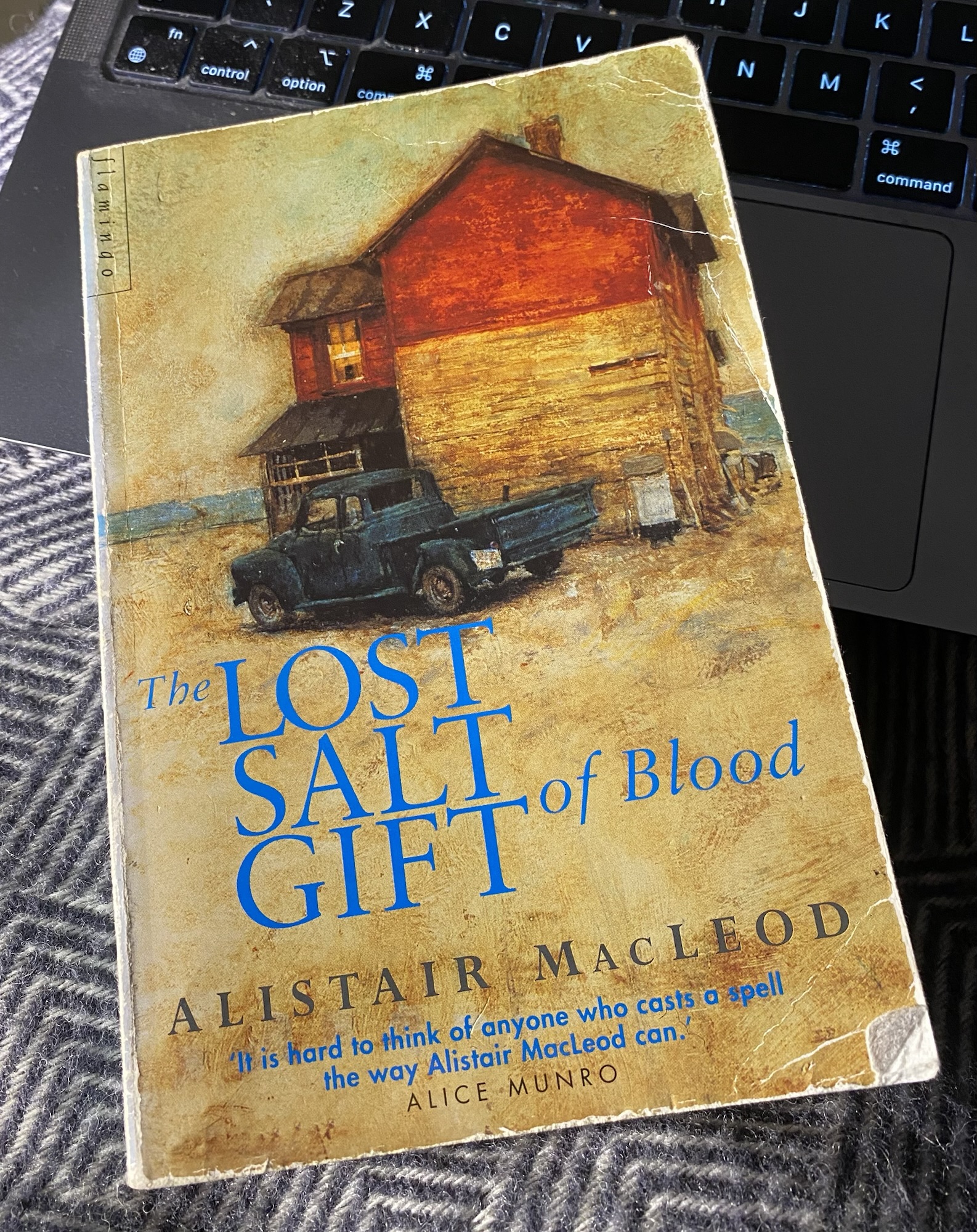
The other, Alistair MacLeod’s The Lost Salt Gift of Blood, I’ve had hanging about on shelves for around twenty five years. Never quite getting around to reading it. Finally, prompted by a move from family house to post-divorce flat, I got to it.
All of the stories are set in Canada’s remote Cape Breton region in Nova Scotia.
The opening story, The Boat, had me going back to the start and reading it again. It’s that good.
A siren of a story, with the narrator drawing you into a kind of love-story for a lost father. A finer, more enthralling description of an elusive character and his fascinating, sprawling mess of a room – more den – when on shore, I think would be hard to find.
The award for
MOST BRILLIANTLY DESCRIBED MESS OF A BOOK FILLED, ASHTRAY CHOKED BEDROOM, goes to The Boat, by Alistair MacLeod.
Richly Evocative Books Read in 2025, the complete list
(these appear in reverse order of when read – the most recent at the top).
Poetry (35)
Changeling – Clare Pollard
The Dread Affair Benjamin Zephaniah
Suckle – Roger Robinson
Grey Time – Julia Webb
Guerilla Country – Phil Vernon
Selected Poems – Randall Jarrell
Night Photograph – Lavinia Greenlaw
A fondness for the colour green – Charlie Bayliss
Division Street – Helen Mort
New and Selected Poems – Pat Boran
C+nto and Othered Poems – Joelle Taylor
A World Where News Travelled Slowly
Something Crosses My Mind – Wang Xiaoni
Gone – Fanny Howe
Never – Jorie Graham
Beginnings Over and Over: Four New Poets from Ireland
Mai Ishikawa, Róisín Leggett Bohan, Emer Lyons, and Cal O’Reilly, selected by Leanne Quinn
No Map Could Show Them – Helen Mort
Dangerous Enough – Becky Varley-Winter
Gorse Fires – Michael Longley
Then Again – Pat Boran
House Anthems – Ralph Dartford
A Pint for the Ghost – Helen Mort
Hedge School – Pat Boran
I am Not Light – Louise Machen
Greencombe – Ella Duffy
The Aftershock Review – Volume One – Ed. Max Wallis
Citadel – Martha Sprackland
The Ghost Orchid Michael Longley
Egg/Shell – Victoria Kennefick
The Dream of the Unified Fields – Jorie Graham
So Glad I’m Me – Roddy Lumsden
The Book of Love – Roddy Lumsden
Deathless – Catherine Balaq
Kitchen Music – Lesley Harrison
Non fiction (16)
Haunted: The Ghost Stories and Folklore of the British Isles
Whites: On Race and Other Falsehoods Otegha Uwagba
Ghost of an Idea: Hauntology, Folk Horror and the Spectre of Nostalgia – William Burns
All the Devils are Here – David Seabrook
Literary Hauntings: A Gazeteer of Literary Ghost Stories – R. B. Russell
Uncommon People: Britpop and Beyond in 20 Songs – Miranda Sawyer
Is a River Alive? – Robert Macfarlane
The Economic Consequences of Mr Trump: What the Trade War Means for the World – Phillip Coggan
Super Infinite: The Transformation of John Donne – Katherine Rundell
The North Road – Rob Cowen
Twenty-First Century Tolkien: What Middle Earth Means to Us Today
Craft: A Guide to Making Poetry Happen in the 21st Century
How to Write It – Anthony Anaxagorou
The English Path – Kim Taplin
On Savage Shores: How Indigenous Americans Discovered Europe – Caroline Dodds Pennock
Sea Bean: A Beachcombers Search for Magical Charm – Sally Huband
Ficton (7)
Helm – Sarah Hall
Beyond Black – Hilary Mantel
The Uninvited – Dorothy Macardle
Hagstone – Sinéad Gleason
The Beast in the Shadows – Edagowa Rampo
The Buffalo Hunter Hunter – Stephen Graham Jones
Climbers – M John Harrison
Short Stories (2)
The Haunted Trail: Classic Tales of the Rambling Weird – Weird Walk – British Library
The Lost Salt Gift of Blood – Alistair MacLeod


 Richly Evocative