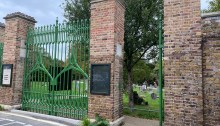
Three Cheers for a cemetery gate
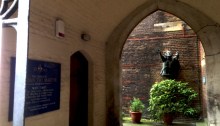
In praise of small things, especially a new cemetery gate.
In praise of small things, especially a new cemetery gate.
Some places are so famous, so iconic, it might be said that they visit you long before you return the favour…

Where were the bored teenagers, the drunks, shouting kids, people laughing, shouting into mobile phones? Stray cats. Lost dogs. Lost souls. In this city of banks, presumably there must be squads of stressy men and women in tight blue suits pushing through the crowds, busy busy busy? Where was the noise, the random, the edge?
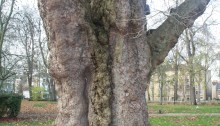
This is a poem I shared on #TopTweetTuesday, an inclusive forum on Twitter for sharing poems every Tuesday – a lovely initiative from https://www.blackboughpoetry.com My ever-present, sleeve-tugging inner punster, almost had me call it Plainsong – but I resisted. It’s a familiar tree, though perhaps not as celebrated as some others. I actually prefer its…
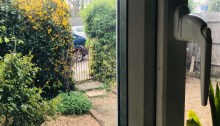
At first glance, there’s not much to see. At second glance, not much more. There are two hedges either side of a gate, rectangular slabs of green, largely blocking sight of the road beyond. They’re a little raggedy, but provide a popular skulking place for the local Dunnock; especially the hedge on the left, technically forsythia, but mostly serving as a framework for ivy. Though currently, scruffy spears are poking up, dotted with those cheerfully in-your-face lemon yellow flowers.

The day Bristol Museum and Art Gallery’s Chinese Room disappeared, was the day I first realised that places, like people, can change. It came as something of a shock.

mid-stream on a shit-spattered barge,
cormorants unfold themselves as crosses,
anchored to a Thames, expectant

For a long time it didn’t have a name. It was just the lane that ran along the back of Mum and Dad’s bookshop…Eventually, I was to discover that there was a lot more to this old city route than I could possibly have imagined.
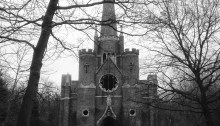
To the left of the hostel, and contrasting with its lime-white walls, the soot darkened, red and yellow bricks of St Alban the Martyr, stretch up and up – in one direction forming the church’s hulking tower, in another eventually tapering into a gabled roof with turrets, topped with a crucifix – and just a little lower down, mammon’s TV aerial.
St Alban’s grand scale crammed into a tight spot, give this half-hidden Neo Gothic edifice an uncomfortably, squeezed appearance; like a fat parochial priest squashed into the corner of a Southern Train vestibule.
It doesn’t take much to make a familiar place unfamiliar. A change in the weather – rain, bright sunshine, or more dramatically, snowfall or fog can all do it. Smells too – who hasn’t found themselves aware of sniffing more consciously than normal when drains are blocked, or there’s a whiff of barbecue, bonfire or worse in the air?
And then of course there are a place’s distinctive sounds.

I recently went in search for an ‘anonymous suburb’.
This is what I discovered.

Norwood is yawning but awake: shopping, grabbing coffee, heading for breakfast, haircuts, workouts, dates. Watching Saturday unfold beyond the cemetery gates, it’s a little difficult to picture a time when almost none of this was there.
In 1837 London was growing rapidly and expanding at the edges. The city had an urgent need for space and not just for its living. Traditional city centre churchyards and dissenters’ burial grounds were full to bursting – the metropolitan dead also needed somewhere to go.

Wherever you find yourself in Bristol, a hill will be lying in wait. South Bristol even has a whole area seemingly named in jokey reference to its steep streets – Totterdown.
My favourite though, will always be Brandon Hill – scene of public protest, fake duels, restrictive carpet beating and for a long time, hermit’s cells.

An ordinary looking grassy field, at the foot of Gipsy Hill in South London, turns out to be anything but…

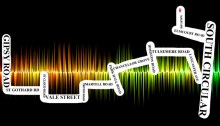
Not far from where I work in Clerkenwell, a series of large orange and white flags fixed to lampposts line the major thoroughfares running through Holborn, Chancery Lane, Bloomsbury and St Giles. They state blithely that you are InMidtown, before in tiny print, grudgingly acknowledging the actual names of the places they are attempting to reinvent.
Stamford Hill Motors is not the most romantic of destinations, but I always feel a frisson of excitement when I have to go there. I used to live nearby but no longer, so the annual MOT has become an excuse to visit one of my old North London haunts. It also gives me a legitimate reason to simply…
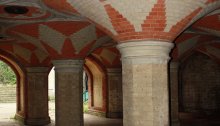
Crystal Palace, geographically at least, is defined by its height: Palace = Hills.
But, hidden beneath busy Crystal Palace Parade, there is something else, a stunningly beautiful place that is usually inaccessible to the public.
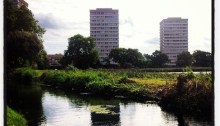
I must admit that when I first heard about the campaign to make London the world’s first National Park City, I thought it was a joke.
And yet the more I thought about it, the more interesting the concept became.

It gives me hope a place like this. A small brown sign outside the Queen’s Hotel, Church Road the only local clue. Stambourne Woods this way, down that gravel drive and through the gate. On the house next door another sign gives red framed warning of a moose who isn’t there. This sliver of…

You can tell a lot about a place from the local shops.
Especially on Norwood Road.
 Richly Evocative