A glimmer of hope on a street corner: Tritton Vale Pocket Garden
How a once-derelict patch of ground, is helping to galvanise a community in one corner of South London.
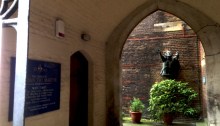
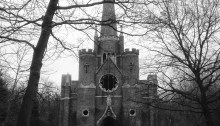
To the left of the hostel, and contrasting with its lime-white walls, the soot darkened, red and yellow bricks of St Alban the Martyr, stretch up and up – in one direction forming the church’s hulking tower, in another eventually tapering into a gabled roof with turrets, topped with a crucifix – and just a little lower down, mammon’s TV aerial.
St Alban’s grand scale crammed into a tight spot, give this half-hidden Neo Gothic edifice an uncomfortably, squeezed appearance; like a fat parochial priest squashed into the corner of a Southern Train vestibule.
As a child of second-hand booksellers I had ready access to books and their offshoot – bookmarks. I recently rediscovered a box filled with some that once upon a time I had hoarded.
It doesn’t take much to make a familiar place unfamiliar. A change in the weather – rain, bright sunshine, or more dramatically, snowfall or fog can all do it. Smells too – who hasn’t found themselves aware of sniffing more consciously than normal when drains are blocked, or there’s a whiff of barbecue, bonfire or worse in the air?
And then of course there are a place’s distinctive sounds.
At the inaugural Balham Literary Festival, a gathering of Nature Writers, Landscape Writers and Writer writers came together to discuss the state of the natural world. Here’s my report on what I saw and heard.
Is it acceptable to call replica Sphinxes ‘The Guys?’ Who is The Headless Lady with no arms (who has arms)? What terrors await when you stop paying attention in the maze?
Is it possible to be haunted by a place? I think that I may be. In this case it is Ashley Vale in Bristol – an exceptional urban oasis caught between the tracks, containing allotments, woods, hilltops and a pub next door to a farm.
I recently went in search for an ‘anonymous suburb’.
This is what I discovered.
Today a coffee shop near where I work in Clerkenwell disappeared…
It’s dark. It’s raining. January is upon us and the season of reflection, projection and resolve is underway. For voracious readers, this means that the perennial question: what to read next will be nagging at their shoulders more urgently than ever.
Let’s say I was there.
For work.
In a hotel near three reservoirs for Wigan.
Let’s say I slipped out back on an unexpected walk,
on a circular path…
Norwood is yawning but awake: shopping, grabbing coffee, heading for breakfast, haircuts, workouts, dates. Watching Saturday unfold beyond the cemetery gates, it’s a little difficult to picture a time when almost none of this was there.
In 1837 London was growing rapidly and expanding at the edges. The city had an urgent need for space and not just for its living. Traditional city centre churchyards and dissenters’ burial grounds were full to bursting – the metropolitan dead also needed somewhere to go.
Wherever you find yourself in Bristol, a hill will be lying in wait. South Bristol even has a whole area seemingly named in jokey reference to its steep streets – Totterdown.
My favourite though, will always be Brandon Hill – scene of public protest, fake duels, restrictive carpet beating and for a long time, hermit’s cells.
This post originally began as a rant about ‘gatekeeping’ in so-called ‘New Nature Writing’. Since then, I’ve tightened it up a little, and updated some of the links, esp. re lack of diversity in nature writing, creeping nativism and more.
I’m back. It’s been a while. The woods behind my parents’ house on Tickenham Ridge haven’t changed hugely in the last few months – the seasons have cycled through and for now the hill is a shining riot of green in a dozen shades.
An hour earlier I was in these woods in company with my two boys, my sister, brother-in-law, two nephews and my Dad, but this time I am alone and things feel different.
An ordinary looking grassy field, at the foot of Gipsy Hill in South London, turns out to be anything but…
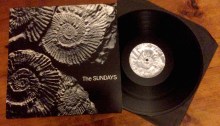
In my teens being there mattered. Having, or at least knowing about, the latest album RIGHT NOW was crucial. To my shame I was late to the Cure and late to the Smiths and countless others. But with the Sundays I got there bang on time. As soon as their first album was released in early 1990 I went out and bought it. That made them mine.
Not far from where I work in Clerkenwell, a series of large orange and white flags fixed to lampposts line the major thoroughfares running through Holborn, Chancery Lane, Bloomsbury and St Giles. They state blithely that you are InMidtown, before in tiny print, grudgingly acknowledging the actual names of the places they are attempting to reinvent.
Stamford Hill Motors is not the most romantic of destinations, but I always feel a frisson of excitement when I have to go there. I used to live nearby but no longer, so the annual MOT has become an excuse to visit one of my old North London haunts. It also gives me a legitimate reason to simply…
Crumbling ruins, moonlight, tree-lined walks, bats flitting, owls hooting, wolves howling, trapdoors and darkling cellar stairs…
Ever since I can remember I’ve been attracted to things that might be termed ‘Gothic’. For that reason I have been looking forward enormously to the latest exhibition at the British Library: Terror and Wonder – The Gothic Imagination.